Research
Our research focuses on adaptive signal processing, with a particular emphasis on real-time applications in speech communication, medical signal processing, and underwater systems. We develop, implement, and evaluate signal processing algorithms for challenging acoustic and biomedical environments, ranging from speech enhancement in vehicles to sensor-based medical diagnostics and underwater communication systems.
Speech and Audio Processing
In many applications, such as automotive hands-free telephony or speech dialogue systems, the desired speech signal is disturbed by background noise, including engine or wind noise, as well as by acoustic echoes caused by multipath propagation from loudspeakers to microphones. To reduce these disturbing components while preserving the naturalness of speech, we investigate multi-channel adaptive signal enhancement algorithms.
Our work in speech enhancement focuses in particular on hands-free and in-car communication systems, as well as on signal enhancement for respiratory protection masks. For automotive applications, we use both offline and real-time simulations and evaluate our algorithms in real environments. For this purpose, several vehicles are equipped with conventional and non-conventional microphones, as well as multiple loudspeakers, enabling us to investigate a wide range of acoustic scenarios.
In addition to developing algorithms for localization and beamforming, echo and feedback cancellation, noise reduction, and bandwidth extension, we also study methods for the automatic evaluation of speech quality. This includes both subjective and objective tests, as well as research on realistic environment simulations. In the broader context of automatic system evaluation, we investigate the quality of transmitted speech after complete signal processing chains, for example including speech enhancement, source coding, and network transmission. A key goal is not only to assess the overall quality, but also to identify the technical causes of quality degradation within the processing chain.
Medical Signal Processing and Speech Analysis
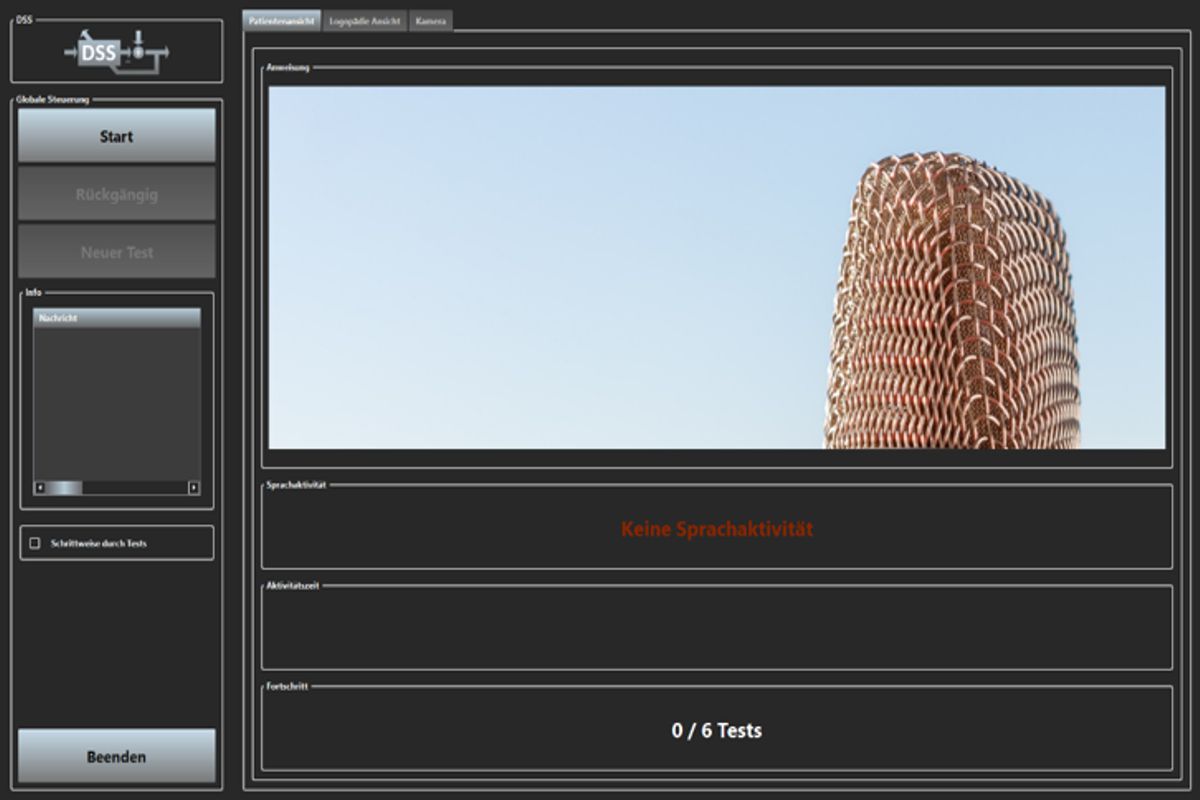 A further research focus is the analysis of biomedical and speech-related signals. In order to investigate speech, it first has to be recorded and analyzed in a reliable and reproducible way. Therefore, one part of our research is the development of an automatic speech recording tool. The tool allows researchers to select different tasks and tests in a modular way. From the recorded speech data, relevant features are extracted and evaluated in order to support therapy planning, patient monitoring, and further diagnostic applications.
The system is designed to provide a simple and intuitive user interface for the participants. Automatic countdowns and instructions enable fast, flexible, and uncomplicated speech analysis in real time. For this purpose, we use tablets equipped with microphones. The system generates a report containing the relevant information and stores the recorded speech data using speech activity detection.
The tool is currently being tested, evaluated, and further developed. Additional speech features are implemented, including within the scope of student theses, in order to obtain a more comprehensive representation of speech quality. We also investigate the subjective perception of speech quality to better understand which speech characteristics are most relevant for listeners and which parameters should be targeted in training to achieve effective improvement.
Another research area is the analysis of Parkinson’s speech. Patients with Parkinson’s disease often suffer from dysarthria, a motor speech disorder. To classify the severity of the disorder and to identify its origin within the speech production process, speech recordings are analyzed using instrumental measures.
Beyond speech analysis, we work on biomedical signal processing for electrical and magnetic measurements of physiological activity, such as signals from the heart, brain, or nerves. While established electrical methods include electrocardiography, electroencephalography, and electroneurography, magnetic measurement methods such as magnetocardiography, magnetoencephalography, and magnetoneurography can provide complementary diagnostic information. Since conventional magnetic measurement systems based on SQUIDs are often very expensive to operate, we investigate alternative sensor technologies based on the magnetoelectric effect. These sensors are promising candidates for biomedical applications, but they are also sensitive to mechanical vibrations. To reduce unwanted signal components, we develop adaptive cancellation methods using non-magnetic reference sensors and implement these approaches in real time with our own software tools.
Furthermore, we conduct research on brain-computer interfaces, currently based on electrical interfaces and, in the future, potentially also using magnetoelectric sensors.
Signal Processing for Underwater Applications
Due to the location of the Faculty of Engineering at Kiel University directly at the Kiel Fjord, our chair is also active in signal processing for underwater applications. This research area includes MIMO sonar signal processing, cognitive systems, underwater communication, and underwater magnetic signal processing.
Our current work combines research on MIMO processing and cognitive systems, with a particular emphasis on the development of MIMO-based methods. Previous research also addressed Kalman-filter-based tracking approaches, as well as the detection and classification of sounds produced by marine mammals.